Home Septic Guide Septic glossary
Reference
Septic glossary: the terms, explained
Septic has its own vocabulary. Here are the words you’ll hear from inspectors, permit offices and septic crews around Cleveland, explained in plain English, with links to the full guides.
A to Z
Plain English
Links to full guides
Quick answer
What are the main parts of a septic system called?
The main parts are the septic tank, the inlet and outlet baffles, the effluent filter, the distribution box and the drain field. Systems on sloped lots may add a pump chamber with an effluent pump, floats and an alarm. Risers bring the tank lids up to ground level.
Tank
Holds and separates waste
Field
Treats the liquid in soil
Baffles
Keep solids in the tank
Tank terms
What do the septic tank terms mean?
| Term | Meaning |
|---|---|
| Septic tank | A buried tank that separates solids from liquid. Learn more |
| Sludge | Heavy solids that settle to the bottom of the tank. Learn more |
| Scum | Grease and light material that float on top. Learn more |
| Effluent | The clearer liquid that leaves the tank for the drain field. |
| Baffle | A part at the inlet or outlet that keeps solids in the tank. Learn more |
| Sanitary tee | A plastic T-fitting used as a baffle. Learn more |
| Effluent filter | A screen in the outlet that catches small solids. |
| Riser | A pipe that brings the tank lid up to ground level. Learn more |
| Compartment | A section of the tank; many tanks have two. |
Field terms
What do the drain field terms mean?
| Term | Meaning |
|---|---|
| Drain field | Trenches of perforated pipe and gravel where effluent soaks into the soil. Learn more |
| Distribution box (D-box) | A small box that splits flow evenly between trenches. |
| Biomat | A dark layer that forms in soil under the trenches; too thick and the field fails. Learn more |
| Perc test | A test of how fast water soaks into soil; part of a soil evaluation. Learn more |
| Saturated soil | Soil so full of water it can’t take more, common after heavy rain. Learn more |
Pump and permit terms
What do pump and permit terms mean?
| Term | Meaning |
|---|---|
| Pump chamber | A tank after the septic tank that holds the effluent pump. Learn more |
| Effluent pump | Moves effluent from the chamber to the field. Learn more |
| Float switch | Turns the pump on and off as the level changes. Learn more |
| Grinder pump | Chops raw sewage so it can be pumped, usually to a sewer. Learn more |
| TDEC | Tennessee Department of Environment and Conservation; issues septic permits in most counties. Learn more |
| SSD permit | Subsurface sewage disposal permit, the formal name for a septic permit in Tennessee. |
| Soil evaluation | A site study of the soil that decides system type and size. Learn more |
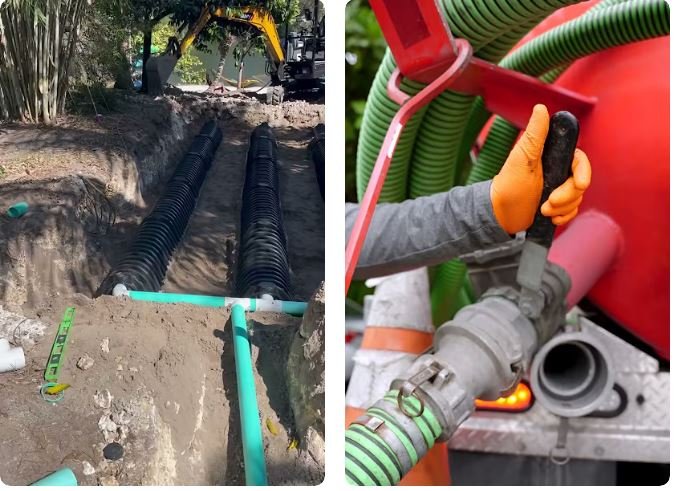
We answer these calls across Cleveland (37311, 37312, 37323), Charleston and Calhoun, Georgetown, McDonald and Hopewell, Ooltewah, Harrison, and Benton and Ocoee, across Bradley, Hamilton, Polk and McMinn counties. See all service areas.
FAQ
Questions we hear about this
What is the difference between sludge and scum?
Sludge sinks to the bottom; scum floats on top. Both are pumped out.
What is effluent?
The clearer liquid that leaves the tank and goes to the drain field.
What is a D-box?
A distribution box that splits flow between drain field trenches.
What does SSD mean in Tennessee?
Subsurface sewage disposal, the formal term for septic systems in Tennessee rules.
What is a septic riser?
A pipe that brings the lid up to ground level so the tank can be reached without digging.
Related: How septic systems work · Septic FAQ · Septic guide · Septic tank baffles
Last updated October 3, 2026.
Still have a septic question?
Call and ask. Plain answers, no pressure.