Home Drain Field Repair
Drain field repair · Cleveland, TN
Drain Field Repair in Cleveland, TN
Soggy yard, sewage smell or drains that crawl after every rain? Your field lines may be struggling. We find out why first, then show you the options, from simple fixes to a full replacement.
Diagnosis before digging
TDEC repair permits handled
Clay-soil experience
Quick answer
How much does drain field repair cost in Cleveland, TN?
It depends on how much of the field has failed. Small fixes like leveling the distribution box or clearing the lines cost far less than replacing trenches. A full drain field replacement typically runs $8,000 to $20,000 or more, depending on the size of the field, the soil, and what TDEC requires for your lot.
Small fixes
D-box, cleared lines, resting the field
Partial
Replacing or adding some trenches
$8,000–$20,000+
Full replacement
The basics
What does a drain field actually do?
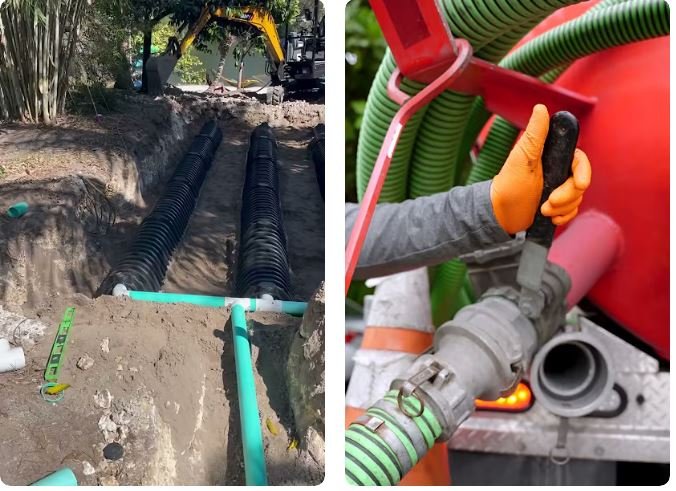
Your septic tank separates the solids. The liquid that leaves the tank, called effluent, flows to a distribution box and out into the field lines: perforated pipes in gravel trenches buried in your yard. The soil around those trenches filters and absorbs the water. When the soil cannot take water fast enough, or gets sealed off with solids, the whole system backs up.
Signs your drain field is failing
- Soggy or spongy ground over the field lines, even in dry weather
- Grass that is much greener over the field than the rest of the yard
- Sewage smell outside, especially near the field
- Slow drains and gurgling all over the house
- Backups that get worse after heavy rain
- The tank fills back up quickly after pumping
What causes it
Why drain fields fail around Cleveland
Skipped pump-outs
When a tank goes too long without pumping, solids wash out into the field lines and seal the soil. This is the number one cause.
Clay soil and heavy rain
Much of Bradley County is slow-draining clay, and the area gets around 50 inches of rain a year. Fields here have less room for extra water.
High water near rivers and the lake
Low ground along the Hiwassee River and near Chickamauga Lake can sit wet for long stretches, which leaves the field nowhere to drain.
Tree roots
Roots find the pipes and fill them. Big hardwoods near older fields are a common problem.
Vehicles and weight
Parking, driving or moving equipment over the field crushes pipes and compacts the soil.
Too much water at once
Laundry marathons, leaking toilets and gutters dumping onto the field overload it.
How we diagnose
How we figure out what is wrong with your drain field
- Check the tank first. The level and condition of the tank tell us if it has been sending solids to the field.
- Open the distribution box. A tipped or settled D-box sends all the water down one line and floods it while the others sit dry.
- Probe and look at the field. We check where it is wet, where it is dry, and whether surface water is running onto it.
- Camera or clear the lines when needed, to find crushed pipe, roots or blockages.
- Explain the options with costs, starting with the least expensive fix that will actually work.
Your options
Drain field repair options, from simplest to biggest
| Option | When it works | Permit? |
|---|---|---|
| Pump the tank and rest the field | Field is overloaded, not destroyed | No |
| Fix water sources (gutters, leaks, laundry habits) | Too much water is the cause | No |
| Level or replace the distribution box | One line is flooding, others dry | Usually no |
| Clear or jet the field lines | Roots or buildup in the pipes | Usually no |
| Replace or add trenches | Part of the field has failed | Yes, TDEC repair permit |
| Full drain field replacement | The soil is sealed across the field | Yes, TDEC repair permit |
We tell you honestly if a simple fix has a real chance before you spend thousands on trenches.
Tennessee rules
Do you need a permit to repair a drain field in Tennessee?
Yes, for anything that repairs, extends or replaces the field itself. In Tennessee, septic systems are permitted through the Tennessee Department of Environment and Conservation (TDEC). A repair permit may involve looking at the soil on your lot, and the new work is inspected before it gets covered up. Simple work like leveling a distribution box or clearing lines usually does not need a permit. We tell you which applies before any work starts.
Protect it
How to protect your drain field
Pump on schedule
Every 3 to 5 years keeps solids in the tank, not the field.
Point gutters away
Downspouts dumping onto the field add hundreds of gallons in a storm.
Keep weight off
No parking, driving, sheds or pools over the field lines.
Spread out laundry
One load a day instead of five on Saturday.
Service area
Where we work around Cleveland
Cleveland and the rest of Bradley County, plus nearby Ooltewah, Harrison, Benton and Ocoee.
Cleveland
South Cleveland
Charleston
Calhoun
McDonald
Georgetown
Hopewell
Ooltewah
Benton
Ocoee
Harrison
Zip codes: 37311, 37312, 37320, 37323, 37364. All service areas →
FAQ
Drain field questions
How long does a drain field last?
With regular pumping and no heavy traffic over it, a drain field often lasts 20 to 30 years or more. Skipped pump-outs, heavy water use and compacted or saturated soil shorten that a lot.
Can a failing drain field be saved?
Sometimes. If the field is overloaded rather than destroyed, resting it, fixing the cause, clearing the lines or leveling the distribution box can bring it back. If the soil around the trenches is sealed with solids, part or all of the field needs replacing.
Does drain field repair need a permit in Tennessee?
Yes. Repairing, extending or replacing a drain field needs a repair permit through the Tennessee Department of Environment and Conservation (TDEC), and the work is inspected before it is covered. Your contractor should handle the paperwork.
Why is there standing water over my drain field?
Either the field cannot absorb what the house sends it, or the ground is already full of water after heavy rain. If it only happens after storms and dries out, the field may be struggling. If it stays wet in dry weather, the field is likely failing.
Will pumping my septic tank fix a soggy drain field?
Pumping gives the field a short break, but it does not fix a failing field. It is still worth doing first, because it tells us whether the tank was overloaded and sending solids out.
Can I plant or build over my drain field?
Grass is best. Keep trees, gardens, sheds, driveways, pools and parked vehicles off it. Roots clog the lines and weight compacts the soil.
Do septic additives fix a failing drain field?
No additive can unclog soil that has sealed up with solids. Save the money for pumping and a proper diagnosis.
How long does a drain field repair take?
Small fixes like leveling a distribution box or clearing lines can take a day. A new or extended field usually takes longer, because it needs a TDEC permit and the right weather to dig in clay.
Related: Septic tank pumping · Septic repair · Emergency septic service · Septic pumping cost
Last updated September 2026.
Soggy yard or slow drains?
Call and tell us what you are seeing. We will start with the tank and work out from there.