Home Septic Guide Clay soil and septic
Local guide
Clay soil and septic systems in Bradley County
Dig anywhere around Cleveland and you’ll hit it: sticky red clay that holds water like a sponge. It’s the single biggest reason septic systems here need bigger fields, more careful pumping and extra attention in wet weather.
Why clay is hard on fields
What it means for you
How to protect your field
Quick answer
Is clay soil bad for septic systems?
Clay soil isn’t impossible for septic, but it drains slowly, so drain fields need more trench length and have less room for extra water. In Bradley County, where around 50 inches of rain falls in a typical year, clay fields fill up fast in wet months. Regular pumping and keeping runoff off the field matter even more.
Slow
How clay takes in water
Bigger
Fields needed on clay
~50 in.
Yearly rain around Cleveland
Why clay
Why is clay soil hard on drain fields?
Slow soaking
Tiny clay particles leave little room for water to move.
Stays wet
After rain, clay holds water for days or weeks.
Clogs easily
Solids from an overdue tank seal the clay around trenches.
Shrinks and swells
Wet winters and dry summers shift pipes and D-boxes.
Permits
What does clay mean for a new septic system?
The soil evaluation measures how fast water moves through your soil. On slow clay, the permit usually calls for longer trenches or an alternative design. Rock close to the surface, common near the ridges toward Polk County, can limit how deep trenches go. See TDEC septic permits.
Protect it
How do you protect a drain field on clay?
- Pump every 3 to 5 years, a bit early rather than late
- Fit an effluent filter so fewer solids reach the field
- Send gutters, sump pumps and yard runoff away from the field
- Spread laundry through the week
- Keep vehicles off the field, especially when it’s wet
- Plant only grass over the lines
Other soils
How does septic differ across the service area?
| Area | Typical ground | What to watch |
|---|---|---|
| Cleveland and north Bradley | Red clay | Slow fields, wet winters |
| Hiwassee River bottoms | Wet, low ground | High water in spring |
| Polk County ridges | Shallow soil over rock | Pumps, risers, digging |
| Chickamauga Lake lots | Slopes near water | Pumps and alarms |
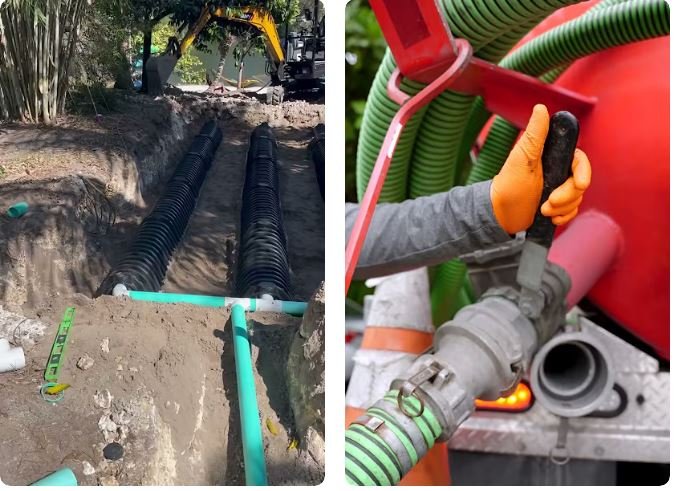
We answer these calls across Cleveland (37311, 37312, 37323), Charleston and Calhoun, Georgetown, McDonald and Hopewell, Ooltewah, Harrison, and Benton and Ocoee, across Bradley, Hamilton, Polk and McMinn counties. See all service areas.
From our crew
What does clay look like on our jobs?
If you’ve dug in a Cleveland yard, you know.
- It sticks to everything. Wet clay makes digging for lids slow, which is why we push risers.
- It shows water. Soggy spots over a clay field are easy to spot.
- It hides lids. Years of topsoil over clay bury lids deep.
- It forgives slowly. A clogged clay field rarely comes back without new trenches.
FAQ
Questions we hear about this
Can you put a septic system in clay soil?
Yes. Permits usually require a larger field or an alternative design.
Why does my septic back up when it rains?
Clay fills with water and can’t take more from the tank. See backup after heavy rain.
Does clay soil mean I need to pump more often?
Not necessarily, but pumping on time protects a clay field from solids.
What is a perc test?
A test of how fast water soaks into soil. In Tennessee it’s part of the soil evaluation for a permit.
Can a clay drain field be fixed?
Sometimes. Crushed lines or D-boxes can be repaired; clogged clay usually needs new trenches.
Related: Drain field repair · Drain field failure signs · Backup after heavy rain · TDEC septic permits · Getting the tank pumped
Last updated October 3, 2026.
Septic trouble on clay ground?
Call and we’ll check the tank and the field.