Home Finding Your Septic Tank
Septic tank locating · Cleveland, TN
How to Find Your Septic Tank (and Field Lines) in Cleveland, TN
Bought an older place, never had to deal with it, or trying to remember where it is in the middle of a backup? Here is how to find your septic tank and field lines, what records to check, and when to call us to find it for you.
Tank and field lines located
TDEC records checked
Riser option so you never dig again
Quick answer
Where is my septic tank?
Most septic tanks sit about 10 to 25 feet from the house, in a straight line from where the main sewer pipe leaves the foundation. The fastest way to find yours is to check the TDEC septic permit for your property, which often includes a sketch. If there is no record, a technician can locate it with a probe or a pipe locator.
Once the tank is found, the next step is usually a pump-out. See septic tank pumping in Cleveland, TN.
Do it yourself first
How do you find your septic tank?
- Check the permit records. Search TDEC’s septic permit records by your address or county. Many permits show the tank and field line layout.
- Ask for the paperwork. Your home inspection report, closing documents or the previous owner may have a sketch.
- Find where the sewer pipe leaves the house. Look in the crawl space or basement, or for a cleanout pipe outside. The tank is usually straight out from there.
- Look at the yard. A slight dip, a patch where grass grows differently, or a spot where snow melts first can give it away.
- Probe gently. A thin metal rod pushed into the soil every couple of feet along the line will hit the concrete lid. Call Tennessee 811 before you dig.
- Stop at the lid. Do not open it. Mark the spot and call for service.
Local know-how
Why are septic tanks hard to find around Cleveland?
Older homes, missing records
Plenty of homes around Bradley County have tanks older than anyone living there, with no permit sketch on file.
Hilly, regraded lots
Lots that were leveled or built up over the years can leave the lid much deeper than it started.
Rocky ground
Out toward Georgetown Road, Dalton Pike and Waterlevel Highway, rock makes probing and digging slow.
Mobile homes moved in later
Tanks put in for an earlier home may not line up with where the current home sits.
When to call us
How do we locate septic tanks and field lines?
- Records first: we check for a TDEC permit and any sketch before we start probing.
- Probing: a steel probe along the line from the house finds the tank lid.
- Pipe locating: a transmitter on a camera or push rod is sent down the line and traced from above, useful for deep tanks and field lines.
- Field line mapping: we trace the lines out from the distribution box so you know where not to trench, fence or build.
- Mark it for good: we can install a riser so the lid sits at ground level from now on.
Planning to trench, fence, add on, or plant trees? Have the tank and field lines located first. It is far cheaper than repairing a crushed line.
Never search again
How do you keep your tank easy to find?
The best fix is a riser: a sealed extension that brings the lid up to ground level, with a secure cover. Next time you need a pump-out, or have a backup on a holiday weekend, nobody has to dig. At the very least, measure from two corners of the house and keep those numbers with your house papers.
Service area
Where do we work around Cleveland?
Cleveland and the rest of Bradley County, plus nearby Ooltewah, Harrison, Benton and Ocoee.
Cleveland
South Cleveland
Charleston
Calhoun
McDonald
Georgetown
Hopewell
Ooltewah
Benton
Ocoee
Harrison
Zip codes: 37311, 37312, 37320, 37323, 37364. All service areas →
Equipment
What tools do we use to find a septic tank?
Probe rods and locator
Finds buried tanks, lids and lines without tearing up the yard.
Sewer line camera
Shows cracks, roots and sags inside the line from the house to the tank.
Hand digging tools
For careful digging near lines, sprinklers and landscaping.
Risers and tight lids
Brings lids to ground level so future pump-outs need no digging.
Vacuum pump truck
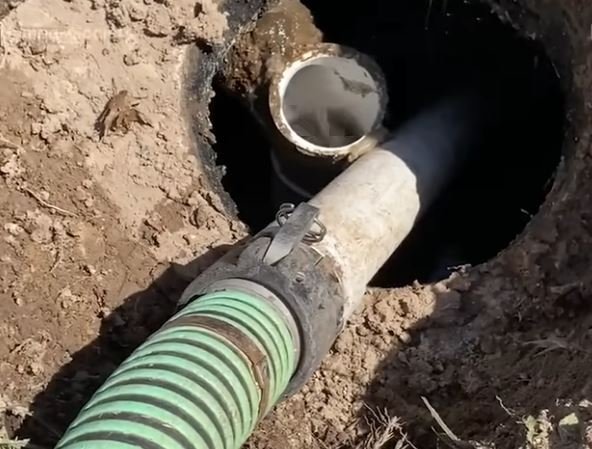
Sized for home tanks, with long hose runs for tanks set back from the driveway.
Soil auger and probe
To check how wet the soil is and how deep the clay sits over the field.
Local case example
Example: finding a tank with no records in Benton
The problem
The owners of an older home had no drawing of the system and could not find the tank.
What we found
Using the cleanout pipe and probe rods, we found the tank about 14 feet from the house, 2 feet down.
What we did
Uncovered the lids, marked the spot and drew a simple map for the owners.
The result
They now know where the tank is. We suggested a riser so no one has to dig again.
Example scenario based on common jobs in our area. It is not a customer review.
Our promise
What can you count on from us?
Firm price first
You get a price range on the phone and a firm price on site before work starts.
See what we see
We show you the tank, baffles and parts we checked, and send photos if you ask.
Permits handled
Work that needs a TDEC or Hamilton County Groundwater permit is done under that permit.
Work we stand behind
If something we did is not right, call us and we will come back and look.
We answer tank locating calls across Cleveland (37311, 37312, 37323) and South Cleveland, Charleston and Calhoun, Georgetown, McDonald and Hopewell, Ooltewah, Harrison, and Benton and Ocoee, across Bradley, Hamilton, Polk and McMinn counties. See all service areas.
From our crew
Where do we usually find tanks around Cleveland?
After enough years probing yards, patterns show up. Here’s where we look first.
- Straight out from the cleanout. Most tanks sit 10 to 25 feet from the house, in line with the main drain.
- Under the newer stuff. Decks, patios and flower beds often got built right over the lid.
- Near the old back door. On older farmhouses, the tank lines up with where the bathroom used to be, not where it is now.
- Deeper than you’d think. Clay and years of topsoil can bury lids 2 feet or more.
FAQ
Finding your septic tank: questions
How far is a septic tank from the house?
Most tanks sit roughly 10 to 25 feet from the house, in line with where the main sewer pipe leaves the foundation. Older and rural homes can be farther out, especially on sloped lots.
How deep is a septic tank lid?
Anywhere from a few inches to a few feet underground. Older tanks and tanks on regraded lots tend to be deeper. A riser brings the lid up to ground level.
Where can I find my septic permit in Tennessee?
TDEC has an online search for septic permit records, and many permits include a sketch of where the tank and field lines are. Search by address, owner name or county.
Can you find my field lines, not just the tank?
Yes. Field lines can be traced from the distribution box by probing and with a locator on a camera or transmitter pushed down the line. It is worth doing before you trench, fence, build or plant trees.
Is it safe to open my septic tank myself?
No. Septic gases can overwhelm a person in seconds, and old concrete lids can crack or give way. Never lean into or enter a tank. Leave opening it to a professional.
Do I need to call 811 before digging for my septic tank?
Call Tennessee 811 before any digging. Buried power, gas, water and communication lines are often near where people look for their tank.
What does septic tank locating cost?
It is quoted based on how much searching and digging is involved. Having your permit sketch or old records ready usually makes it faster and cheaper.
Why should I mark my septic tank once it is found?
So you never pay to find it again. A riser is best. At minimum, mark it with a paver or stake and write the measurements from two corners of the house somewhere you will not lose them.
Related: Find septic permit records · Septic tank pumping · Septic inspections · Emergency septic service · Septic pumping cost · Septic tank openings and lids · Septic excavation
Last updated September 2026.
Can’t find your tank?
Call and we will find the tank, and the field lines if you need them.