Home Septic Guide How septic systems work
How your system works
How does a septic system work?
A septic system is a small wastewater treatment plant buried in your yard. It has two main parts, a tank and a drain field, and the soil does most of the final cleanup. Once you understand how it works, most of the rules for looking after it make sense.
Tank, field and soil
The three layers
Why pumping matters
Quick answer
How does a septic system work, simply?
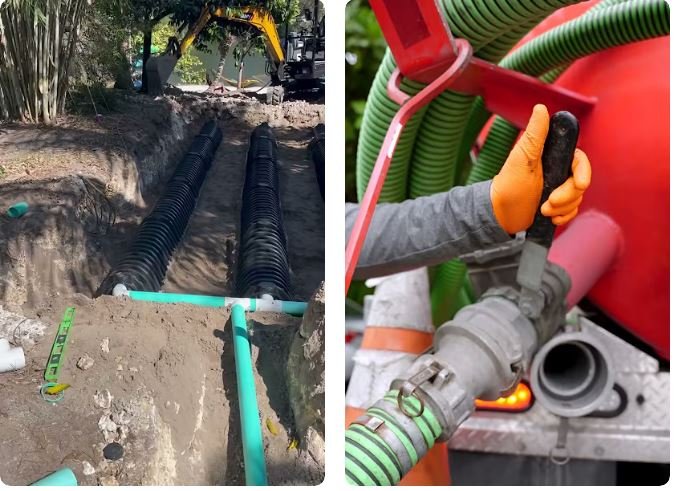
Wastewater flows from the house into the septic tank. Solids sink to form sludge, grease floats as scum, and the clearer liquid in the middle flows out to the drain field. There, perforated pipes spread it into gravel trenches and the soil filters and treats it. Pumping removes sludge and scum before they reach the field.
Tank
Separates solids
Field
Spreads the liquid
Soil
Finishes the cleanup
Step by step
What happens to wastewater, step by step?
- The house drain carries everything from toilets, sinks, showers and the washer.
- The inlet baffle slows the flow as it enters the tank.
- The tank separates it into scum on top, clear liquid in the middle and sludge on the bottom.
- Bacteria break down some of the solids over time.
- The outlet baffle and filter let only the middle layer leave.
- The distribution box splits the flow between trenches.
- The drain field lets it soak into the soil, which filters and treats it.
Parts
What are the main parts of a septic system?
Septic tank
Concrete, plastic or fiberglass; often 1,000 to 1,500 gallons.
Baffles and filter
Keep scum and sludge in the tank.
Distribution box
Splits flow evenly to the field lines.
Drain field
Perforated pipes in gravel trenches.
Pump systems
What if my system has a pump and an alarm?
When the drain field is uphill from the house, or the soil calls for it, a second chamber after the tank holds an effluent pump. Floats switch the pump on and off, and an alarm sounds if the water gets too high. These are common on sloped lots around Ooltewah, Harrison, Benton and Ocoee.
Local soil
Why does soil matter so much around Cleveland?
The soil is the last and most important treatment step. Slow-draining red clay across much of Bradley County means fields have to be bigger, and wet winters can fill the soil so it can’t take more water. See clay soil and septic.
We answer these calls across Cleveland (37311, 37312, 37323), Charleston and Calhoun, Georgetown, McDonald and Hopewell, Ooltewah, Harrison, and Benton and Ocoee, across Bradley, Hamilton, Polk and McMinn counties. See all service areas.
From our crew
What does a healthy system look like when we open it?
Here’s what we like to see when the lid comes off.
- Sludge under a third of the tank. Room to settle.
- A thin scum layer. Not a thick grease cap.
- Both baffles in place. Especially the outlet.
- A clean effluent filter. And a dry, firm yard over the field.
FAQ
Questions we hear about this
Where does the water go from a septic tank?
Into the drain field, where it soaks into the soil and is filtered and treated.
Do septic tanks need bacteria added?
No. Normal waste supplies the bacteria.
What happens if a septic tank is never pumped?
Sludge builds up until solids flow into the field and clog it.
How deep is a septic tank?
Lids are often 6 inches to 2 feet or more below ground; the tank itself is several feet deep.
Can a septic system freeze in Tennessee?
Rarely, but lines under mobile homes or shallow pipes can freeze in hard cold snaps.
Related: Free septic checklists · Septic tank baffles · First-time septic owner · How often to pump · Grinder vs effluent pump
Last updated October 3, 2026.
Want to know how your system is doing?
Book a pump-out and we’ll show you what we see.