Home Septic Guide Clogged Line or Full Tank
Septic guide · Troubleshooting
Clogged Line or Full Septic Tank? How to Tell the Difference
Nothing is draining, and you are not sure whether to call a plumber or a septic company. A few quick checks tell you where the problem is, and can save you from paying for the wrong fix.
No tools needed for most checks
Written for Cleveland-area homes
Updated September 2026
Quick answer
Is it a clogged line or a full septic tank?
If one drain or the lowest drains back up while the rest of the house works, suspect a clogged line. If every drain is slow, toilets gurgle, and you notice odors or soggy ground over the tank or field, suspect a full tank or a struggling drain field. Opening the tank settles it: a normal liquid level means the clog is in the line.
Side by side
What are the signs of a clogged line vs. a full tank?
| Sign | Clogged line | Full tank or drain field |
|---|---|---|
| Which drains | Lowest drain first, or one area of the house | Every drain slows down |
| Toilets | One may back up when another fixture drains | Gurgling across the house |
| Outside | Nothing unusual | Odor, soggy ground or green grass over the tank or field |
| Sewer cleanout | Full of water | May be full, and the tank is high too |
| Tank level when opened | Normal, below the inlet pipe | High, at or above the inlet |
| After heavy rain | No change | Often worse |
| Fix | Clear or jet the line | Pump the tank, then check the field |
Check it yourself
What safe checks can you do in 10 minutes?
- Run one fixture at a time. If only one sink or toilet is slow, it is a plumbing clog in that fixture, not the septic system.
- Watch the lowest drain. Run water upstairs and see if the lowest tub or shower bubbles or fills. That points to the main line or the tank.
- Find the sewer cleanout near the foundation or in the crawl space. Carefully loosen the cap: water standing in it means the blockage is downstream, toward the tank.
- Look at the yard. Odors, soggy ground or bright green grass over the tank or field point to the tank or drain field, not the line.
Safety: never lean over an open septic tank or climb into it. Septic gases can overwhelm a person in seconds. If your lid is buried, leave opening it to a professional.
Who to call
Plumber or septic company?
Call a plumber if…
Only one fixture or one bathroom is affected, or the cleanout is dry. The clog is inside the house.
Call a septic company if…
Several drains back up, the cleanout is full, there are outdoor odors or soggy ground, the septic alarm is on, or it has been more than 3 to 5 years since pumping.
Not sure? A septic company can check the tank level first. If it is normal, the fix is clearing the line, and you avoid paying for a pump-out you did not need.
Prevent it
How do you prevent clogs in your septic line?
Trash the wipes
Even “flushable” wipes do not break down like toilet paper.
Wipe greasy pans first
Grease hardens in the line and in the tank.
Watch the trees
Keep new trees well away from the line and tank.
Pump on schedule
Every 3 to 5 years keeps the tank from backing up into the line.
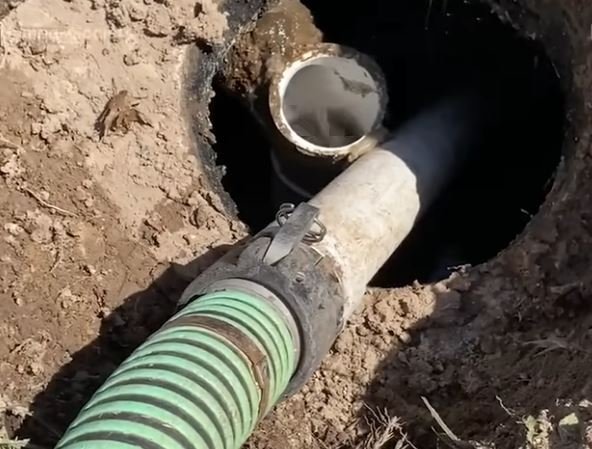
We answer clogged-line calls across Cleveland (37311, 37312, 37323) and South Cleveland, Charleston and Calhoun, Georgetown, McDonald and Hopewell, Ooltewah, Harrison, and Benton and Ocoee, across Bradley, Hamilton, Polk and McMinn counties. See all service areas.
From our crew
How do we tell a clogged line from a full tank on site?
We check before we pump, because pumping a half-empty tank doesn’t fix a clogged pipe.
- We look at the level first. A normal level with a house that won’t drain points to the line.
- We check the cleanout. Water standing in the outside cleanout means the clog is between there and the tank.
- We ask what backs up. One bathroom is plumbing; the whole house is the main line or the tank.
- We run the camera. Roots, sags and wipes all show up on screen, so you see what you’re paying to fix.
Local case example
Example: a slow house near Dalton Pike
The problem
Every drain in the house was slow, and the owner assumed the tank was full.
What we found
The tank was only half full. Water was standing in the outside cleanout, so the clog was in the line.
What we did
Jetted the line from the cleanout and ran the camera. Roots were packed into one joint.
The result
Drains cleared the same visit, and the owner didn’t pay for a pump-out they didn’t need.
Example scenario based on common jobs in our area. It is not a customer review.
FAQ
Clogged line or full tank: questions
How can I tell if my septic tank is full or my line is clogged?
Look at where the problem shows up. A full tank usually slows every drain in the house and often comes with odors or soggy ground outside. A clogged line to the tank usually backs up the lowest drain first, and if you open the tank, the liquid level is normal instead of high.
Can I check the septic tank level myself?
Only if you have a riser with a lid you can lift safely from ground level, and never lean over or into the tank. If the liquid is up near the inlet pipe or higher, the tank or drain field is the issue. If it sits below the inlet pipe, look at the line from the house.
What is a sewer cleanout?
A capped pipe, usually outside near the foundation or in the crawl space, that gives access to the main line. If it is full of water or sewage, the clog is between there and the tank. If it is dry, the clog is inside the house.
Can a plumber clear a septic line clog?
Yes. A line clog between the house and the tank can be cleared by a plumber or a septic company with a snake or jetter. If the tank or drain field turns out to be the problem, you will need a septic company either way.
Will Drano clear a clogged septic line?
Unlikely. Chemical drain openers rarely reach or clear a main line clog, and they are hard on the bacteria your septic tank depends on.
What causes septic line clogs?
Wipes labeled flushable, grease, paper towels, feminine products and tree roots are the usual causes. Older pipes with sagging sections or loose joints clog more often.
Related: Flushable wipes · Still backing up after pumping? · Septic tank pumping · Find your septic tank · Septic guide
Last updated September 2026.
Still not sure?
Call and describe what is backing up. We will help you figure out where to start.
Clogged Line or Full Septic Tank: Quick Recap
If you’re still unsure whether you’re dealing with a clogged line or a full septic tank after running through the checks above, the safest move is to stop using water in the house and call a local septic company before the backup gets worse.
For a plain-language overview of how septic systems fail and why slow drains happen, the EPA’s guide to how septic systems work is a good independent reference.