Home Septic Guide Backing Up After Pumping
Septic guide · Troubleshooting
Septic Still Backing Up After Pumping? 5 Things to Check
You paid for a pump-out, and the tub is backing up again. It happens more than you would think, and it almost always means the tank was not the real problem. Here is what to check before you pay for another pump-out.
Written for Cleveland-area homes
Updated September 2026
5-minute read
Quick answer
Why is my septic still backing up after pumping?
Because pumping only empties the tank. If drains are still backing up after a pump-out, the cause is usually a clog in the line between the house and the tank, a blocked or broken inlet baffle, a clogged effluent filter, a failed pump on a pump system, or a drain field that cannot absorb water.
The 5 usual causes
What causes a septic backup after the tank is pumped?
1. A clog between the house and the tank
This is the most common one. Wipes, grease, paper towels and roots collect in the main line before it ever reaches the tank. The giveaway: when the tank was opened, the liquid level was normal, not high. Pumping cannot reach this clog; clearing or jetting the line does.
2. A blocked or broken inlet baffle
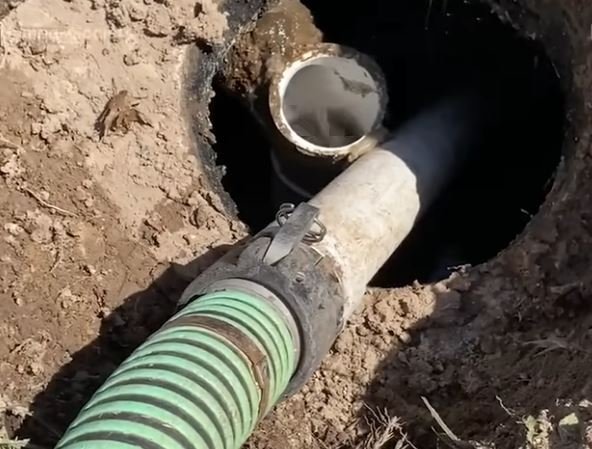
The inlet baffle guides waste into the tank. Old concrete baffles crack and fall off, and plastic ones can clog with a mat of wipes. Sometimes the baffle is simply not where it should be. One homeowner found the baffle covers had not been sitting over the baffles since the tank was installed. A baffle check should be part of every pump-out.
3. A clogged effluent filter
Many tanks have a filter on the outlet side to keep solids out of the drain field. When it clogs, water backs up in the tank and toward the house. It should be rinsed at every pump-out.
4. A failed pump on a pump system
If your system has a pump tank and an alarm, a dead pump or stuck float means water has nowhere to go, whether or not the main tank was just pumped.
Septic pump and alarm repair →
5. A drain field that cannot take water
If the field is saturated after rain or sealed off with solids from years of skipped pumping, it cannot accept water from the tank. A pump-out gives it a day or two of relief, then the backups return. This one is common in clay soil around Bradley County.
Quick diagnosis
Which cause is it? How do you match the clue?
| What you notice | Most likely cause |
|---|---|
| Tank level was normal when opened, house still will not drain | Clog in the line to the tank, or the inlet baffle |
| Backs up the same day it was pumped | Line clog or inlet baffle |
| Works for a day or two, then backs up again | Drain field or effluent filter |
| Septic alarm is on | Pump, float or pump breaker |
| Worse after heavy rain | Drain field saturated, or rainwater getting into the tank |
| Only one fixture is slow | A plumbing clog inside the house |
Before you call
What should you tell the septic company?
- When the tank was pumped, and by whom
- Whether the pumper said the level was high or normal
- Which drains back up, and whether it is the lowest ones in the house
- Whether it gets worse after rain
- Whether you have a pump tank or alarm
- Anything unusual that went down the drains: wipes, grease, paper towels
This information alone often tells a technician where to start, which saves time and money on the visit.
We answer backup calls across Cleveland (37311, 37312, 37323) and South Cleveland, Charleston and Calhoun, Georgetown, McDonald and Hopewell, Ooltewah, Harrison, and Benton and Ocoee, across Bradley, Hamilton, Polk and McMinn counties. See all service areas.
From our crew
What does a backup after pumping usually mean around Cleveland?
When someone calls saying the tank was just pumped and it’s backing up again, it’s usually one of these.
- A missing inlet baffle. Wipes and paper hang up where the pipe enters the tank.
- A clogged line, not a full tank. Roots from oaks and maples find the joints in older clay pipe.
- A soaked drain field. After a wet week, even an empty tank refills and has nowhere to go.
- Only part of the tank got pumped. Pumping through a small inspection port can leave the second compartment full.
Local case example
Example: still backing up two weeks after a pump-out in Hopewell
The problem
The owners had the tank pumped by another company, and the downstairs shower backed up again two weeks later.
What we found
The tank level was normal. The inlet baffle was gone and a mat of wipes was blocking the pipe where it enters the tank.
What we did
Cleared the inlet, fitted a new sanitary tee baffle and ran the camera up the line to confirm it was clear.
The result
No more backups. The fix cost a few hundred dollars, far less than another pump-out.
Example scenario based on common jobs in our area. It is not a customer review.
FAQ
Backing up after pumping: questions
Why is my septic backing up right after it was pumped?
Pumping only empties the tank. If the house is still backing up, the problem is usually somewhere else: a clog in the line between the house and the tank, a broken or blocked inlet baffle, a clogged effluent filter, or a drain field that cannot take water.
How long after pumping should drains work normally?
Right away. A freshly pumped tank has plenty of room, so if drains are still slow or backing up the same day, the tank was not the problem.
Can a septic tank be pumped wrong?
Yes. Pumping only through a small inspection port over a baffle can leave a lot of sludge behind, and a pumper who does not check the baffles can miss the real problem. Ask whether every compartment was pumped through the main lid.
Could the problem be inside my house instead?
Sometimes. If only one sink, tub or toilet is slow and everything else drains, it is usually a clog in that fixture’s pipe, which is a plumbing problem. If several drains are affected, look at the main line and the septic system.
Will it back up again if it rains?
If the drain field is saturated or failing, yes, heavy rain makes it worse. Backups that come and go with the weather point to the drain field rather than the tank.
Should I pump the tank again?
Not until the real cause is found. A second pump-out usually just costs money and buys a day or two.
Related: Flushable wipes · Clogged line or full septic tank? · Septic repair · Emergency septic service · Septic guide
Last updated September 2026.
Still backing up?
Call and tell us when it was pumped and what you are seeing.