Home Septic Guide Septic or sewer?
Local guide
Is your house on septic or sewer?
Inside Cleveland city limits most homes are on Cleveland Utilities sewer. Out toward the county edges, down Dalton Pike and Waterlevel Highway, and across most of rural Bradley County, septic is the norm. Here’s how to know for sure at your address.
5 quick checks
Where sewer ends
What to do next
Quick answer
How can you tell if your house has a septic tank?
Check your water or utility bill for a sewer charge. If there isn’t one, you are probably on septic. Other clues: a septic permit on file, a concrete or plastic lid or riser in the yard, and a pipe cleanout that leads toward the yard rather than the street.
Bill
Sewer charge means sewer
Lid
A buried lid means septic
Permit
TDEC or county records
Checks
What are the quickest ways to tell septic from sewer?
- Look at your utility bill. A sewer or wastewater charge means you’re connected to sewer.
- Ask the utility. Cleveland Utilities can tell you if your address is on sewer.
- Check permit records. A TDEC septic permit on file means a septic system was installed.
- Look for a lid, riser or low mound 10 to 25 feet from the house.
- Follow the cleanout. A cleanout pipe heading into the yard, away from the street, usually leads to a tank.
Local map
Where does sewer end and septic start around Cleveland?
As a rule of thumb, older neighborhoods inside the city are on sewer, while homes toward the edges of town and in the county are more often on septic. Newer subdivisions in Ooltewah and Harrison are often on sewer, but older homes and lake lots nearby commonly aren’t.
Always confirm with the utility for your address; sewer lines change over time as they’re extended.
Inside Cleveland
Mostly Cleveland Utilities sewer, with pockets of septic on older streets.
County edges
Toward the Georgia line, Dalton Pike and Waterlevel Highway: often septic.
North county
Georgetown, McDonald and Hopewell: mostly septic, many older tanks.
Next steps
What should you do once you know you’re on septic?
- Find the tank and mark it
- Find out when it was last pumped
- Learn what not to flush
- Put a pump-out reminder on your calendar
- Read the pumping schedule guide
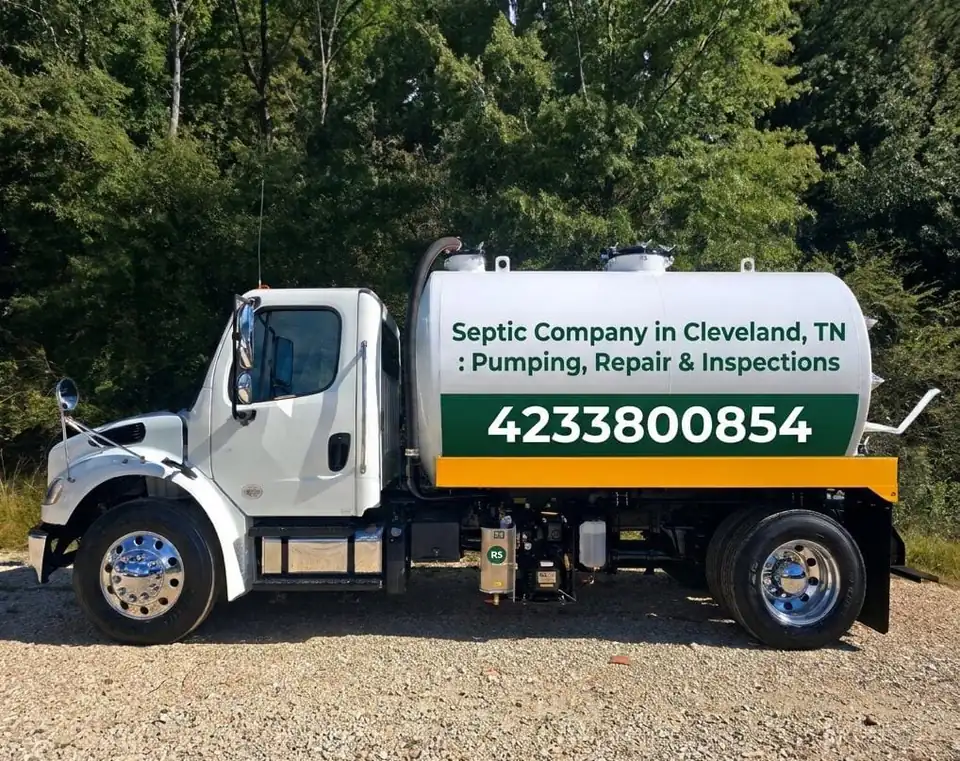
We answer these calls across Cleveland (37311, 37312, 37323), Charleston and Calhoun, Georgetown, McDonald and Hopewell, Ooltewah, Harrison, and Benton and Ocoee, across Bradley, Hamilton, Polk and McMinn counties. See all service areas.
From our crew
What do new owners ask us most?
We meet a lot of people who have just moved from city sewer to a septic home in the county.
- “Do I pay a sewer bill?” Not if you’re on septic. You pay for pumping every few years instead.
- “Where is it?” Usually in line with the main drain, 10 to 25 feet out.
- “Can I use a garbage disposal?” You can, but you’ll pump more often.
- “Can I hook up to sewer?” Only if a line runs close enough. Ask Cleveland Utilities.
FAQ
Questions we hear about this
How do I know if my house is on septic in Cleveland, TN?
No sewer charge on your utility bill is the easiest clue. Cleveland Utilities can confirm for your address.
Do all homes in Bradley County have septic?
No. Many homes inside Cleveland are on sewer. Much of the rural county is on septic.
Can a house have both septic and sewer?
It’s unusual, but some properties have an old tank that was abandoned when sewer came through. It should be properly closed.
Is septic cheaper than sewer?
There’s no monthly sewer bill with septic, but you pay for pumping and occasional repairs.
What if I can’t find my septic tank?
Call a septic company to locate it. See tank locating.
Related: First steps: find your tank · How often to pump · Septic to sewer conversion · Service areas · Pumping your septic tank
Last updated October 1, 2026.
Just moved onto septic?
Call and we’ll find the tank, pump it and show you what to watch for.