Home Septic Guide Drain field replacement cost
Septic cost guide
Drain field replacement cost in Tennessee
Replacing a drain field is the biggest bill a septic owner faces. Here is what it usually costs around Cleveland, what drives the price, and when a repair is enough.
Typical price ranges
Repair vs replace
Permit steps
Quick answer
How much does it cost to replace a drain field?
Around Cleveland and East Tennessee, a full drain field replacement usually costs about $3,000 to $15,000 or more. Smaller repairs, such as fixing a crushed line or a distribution box, often cost far less.
$8K–$20K+
Full field replacement
Much less
Line or D-box repair
Permit
Required for replacement
Repair vs replace
What does drain field work usually cost?
| Job | When it is needed | Typical cost |
|---|---|---|
| Jetting field lines | Sludge build-up in lines with cleanouts | A few hundred dollars |
| Distribution box repair | Box tilted, cracked or blocked | Several hundred to about $2,000 |
| Replace a crushed line section | Vehicle or roots damaged one line | About $1,000 to a few thousand |
| Add or replace trenches | Part of the field has failed | A few thousand dollars |
| Full field replacement | Whole field saturated or failed | $3,000 to $15,000+ |
| Alternative field design | Poor soil or no room for a standard field | Often $15,000+ |
Rough ranges for planning. We confirm the cause with a camera and field check and give a firm price before work starts.
Cost drivers
What pushes the price up or down?
Soil
Bradley County red clay needs longer trenches. Rocky ground takes longer to dig.
Size of home
Fields are sized by bedrooms under the permit.
Gravity or pump
If the new field must go uphill, a pump, chamber and alarm are added.
Space on the lot
A new field must go in suitable soil, away from wells, streams and buildings.
Access
Fences, trees and slopes add labor and restoration.
Permit and design
TDEC or Hamilton County Groundwater fees, plus any design work.
Why fields fail here
Why do drain fields fail around Cleveland?
Cleveland gets about 50 inches of rain a year, and much of Bradley County sits on slow-draining clay. A field that is already working hard gets pushed over the edge when a tank goes years without pumping and solids wash into the lines. Once the soil around the trenches clogs, the only fix is new trenches in fresh soil.
- Pump every 3 to 5 years to keep solids out
- Fit an effluent filter at the tank outlet
- Send gutters and sump water away from the field
- Keep cars, trailers and livestock off the field
Before you replace
What should you check before paying for a new field?
- Pump the tank. A full tank can look like a failed field.
- Camera the lines. A single crushed pipe is a much cheaper fix.
- Check the distribution box. A tilted box can flood one trench and starve the rest.
- Look at water use. Leaks and heavy laundry days can overload a working field.
- Then decide. If the soil itself has failed, replacement is the lasting fix.
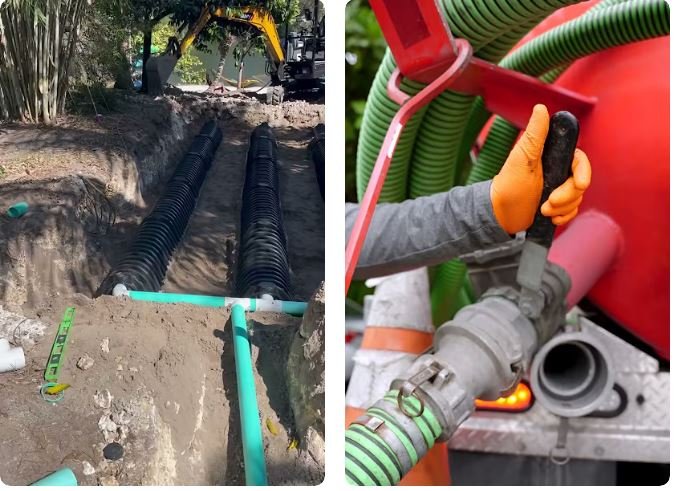
We answer drain field calls across Cleveland (37311, 37312, 37323) and South Cleveland, Charleston and Calhoun, Georgetown, McDonald and Hopewell, Ooltewah, Harrison, and Benton and Ocoee, across Bradley, Hamilton, Polk and McMinn counties. See all service areas.
From our crew
Do you really need a new drain field?
We see a lot of people quoted for a full field when a smaller repair would do. Check these first.
- Was the tank just full? A full tank on a wet week can look exactly like a failed field.
- Is one line crushed? A camera finds it, and one section is far cheaper than a whole field.
- Is the D-box level? A tipped distribution box floods one trench and starves the others.
- Where does the roof water go? Moving one downspout has saved more than one field around here.
Local case example
Example: a “failed” field in Charleston that wasn’t
The problem
A homeowner had been quoted for a full drain field replacement after a wet spring.
What we found
The camera showed one crushed line where a truck had crossed the yard. The rest of the field was working.
What we did
Replaced the crushed section under a TDEC repair permit and moved a downspout off the field.
The result
The field recovered, and the repair cost a fraction of a full replacement.
Example scenario based on common jobs in our area. It is not a customer review.
FAQ
Drain field cost questions
How much does drain field replacement cost in Tennessee?
A full drain field replacement for a typical home usually costs about $3,000 to $15,000 or more. Clay soil, pump systems, alternative designs and difficult access push it to the upper end.
Can a drain field be repaired instead of replaced?
Often, yes. A crushed line, a clogged distribution box or a single failed trench can be repaired for much less. A camera and a field check tell us which you need.
Do I need a permit to replace a drain field?
Yes. Drain field replacement in Tennessee needs a permit from TDEC, or from the Hamilton County Groundwater office in Hamilton County.
How long does a drain field last?
Many last 20 to 30 years or more. Skipped pump-outs, heavy water use, vehicles driving over the field and roof runoff are the main reasons they fail early.
What are the signs a drain field is failing?
Soggy or spongy ground, sewage smell over the field, bright green stripes of grass, and slow drains or backups soon after the tank is pumped.
Related: Drain field repair · Septic system cost in TN · Line jetting & camera · Septic repair · Getting the tank pumped
Last updated September 2026.
Worried your drain field is failing?
Call for a camera and field check before you commit to a replacement.